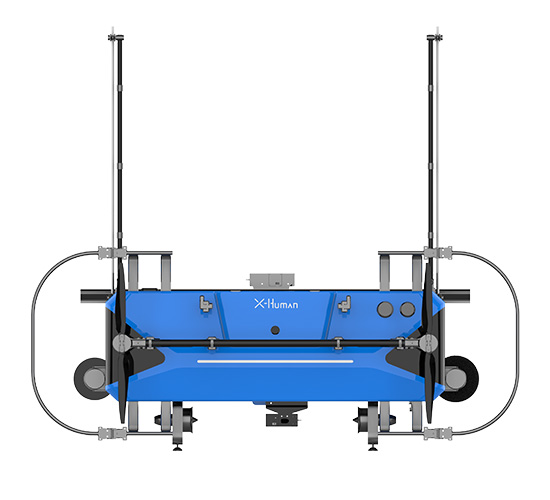
Introduction: A cleaning robot's usable surface is decided by facade geometry and material contact, not by cleaning power alone.
When a building mixes pure flat glass, smooth stone, and micro-curved panels across the same elevation, the machine that cleans one section may not be able to move into the next. The reason is mechanical rather than commercial. Vacuum cups need a continuous plane to seal against, and a squeegee blade needs even pressure along its full length to leave a clean pass. Once raised frames, deep mullions, or strong curvature interrupt that plane, the machine's job stops being cleaning and starts being climbing. This comparison looks at how those three surface conditions differ in daily practice, and where the line sits between a flat-facade robot and an obstacle-crossing machine.
Pure flat glass is the easiest facade for a robot to work on. Panels are manufactured flat, installed in one plane, and joined with narrow sealed joints that stay flush with the glass surface. That gives a vacuum cup a full contact ring and gives a rubber squeegee blade an even line of contact across its width. A high-rise machine such as the K3 is designed around exactly that condition: eight suction units with automatic pressure compensation hold it against the glass, a 1000 mm cleaning head passes over the surface, and the robot travels at 0.2 m/s within a working height range up to 600 m. On this surface the design figures, including the manufacturer-stated 720 ㎡/h cleaning rate, describe the machine's normal working state rather than an optimistic ceiling. Seams between glass panels are the one interruption a flat-facade robot handles routinely. Curtain wall glazing normally includes structural or weather seals between panes, and those joints sit close to flush. A suction cup crossing a narrow flush seam keeps most of its sealing edge on glass, and the brush or squeegee keeps continuous pressure through the pass. That is why these machines can run long unbroken lanes across a whole elevation instead of stopping at every panel line. The published surface list for the K3 covers pure flat glass and pure flat smooth stone, which reflects the same mechanical logic: a surface that stays in one plane lets the machine use its full cleaning width and hold steady traction from the first panel to the last.
Smooth stone behaves like glass in shape but not always in texture. A polished stone panel can be nearly as smooth as glass and can seal well; a honed or lightly textured stone holds water differently, and friction from panel to panel can vary with the finish and the stone type. Smooth stone panels also tend to have wider joints and slightly looser dimensional tolerance between units, which a flat-facade robot bridges well as long as the plane is continuous. Treat smooth stone as a family of surfaces rather than one material, and confirm the actual finish before planning a daily cleaning cycle around it. Micro-curved glass and raised frames then change contact in a different way again.
Micro-curved glass, meaning large-span panels shaped with a gentle radius, turns the flat contact patch a suction cup expects into a shallow dome or trough. A generous radius keeps the deviation small enough that the cup lip can still conform and the squeegee blade can still flex to follow the surface, and large-span micro-curved glass facades are listed as a supported surface for the K3. The practical way to plan around it is conservative: assume sealing and blade pressure are less uniform than on flat glass, expect slightly slower passes over curved bays, and confirm the actual curvature radius with the supplier before putting a curved section on the same schedule as flat glass. Slower passes on a curved bay are ordinary engineering, and knowing that in advance keeps a project timeline realistic.
Mullions and frames are the parts of a curtain wall that sit between or over the glass. In some facades they sit nearly flush; in others they project several centimeters in front of the glass plane, and decorative fins or louvers project further. A flat-facade robot travels as a rigid body within a plane, so a raised frame is a wall it cannot pass. The cup loses its seal at the obstacle, the squeegee lifts off the glass, and the chassis can catch on the projection. Getting past that requires a machine that lifts itself, repositions, and re-seals on the other side, which is the job of an obstacle-crossing design such as the Y3 series. That is a different class of equipment with different mechanics, weight distribution, and operating procedure. Adding suction force does not turn a flat-facade machine into an obstacle-crossing one; the motion itself is different, and so is the way the safety rope and anchor points are managed during a pass.
Buyers tend to compare robots on cleaning width, tank size, or headline cleaning rate, but those numbers only carry meaning once the machine can actually travel across the facade. A 1000 mm cleaning head and a 720 ㎡/h figure both assume a continuous plane to move across. Put the same machine on a facade with deep mullions every couple of meters and the effective rate collapses, because the unit has to stop, get repositioned, or be replaced by a different type of equipment altogether. Surface geometry is the first filter in any selection, and it rules out more machine options than any performance specification does. Shape also decides what the crew does on site. On a flat glass or smooth stone plane the sequence is predictable: anchor the safety rope at roof level, lower the machine, monitor its path, and let it work. Where the facade includes raised frames or louvers, the work plan has to include lifting the machine over each projection or splitting the facade into sections, which changes the number of people needed on the roof, the time per floor, and the overall risk profile. For buildings with mixed facade elements, the common answer is to run a flat-facade robot on the glazed bays and a different machine on the framed or louvered sections, after measuring the deepest projection and the tightest curvature radius on the elevation.
The surface tells you which machine belongs on the job. Pure flat glass and consistent smooth stone let a flat-facade robot seal its cups reliably, hold squeegee contact through long passes, and use its full cleaning width. Gentle large-span micro-curved glass can be supported as well, with the reasonable planning assumption that contact is a little less uniform than on flat glass. Raised frames, deep mullions, and louvers sit outside that working condition and call for an obstacle-crossing design such as the Y3 series. Checking plane, seams, and curvature radius early saves rework later. The published K3 surface list — pure flat glass, pure flat smooth stone, and large-span micro-curved glass — is the fastest reference point for that first check.
A:Pure flat glass is the core case, because a continuous plane lets suction cups seal fully and keeps a squeegee blade in even contact across its width. Narrow flush panel seams between panes are handled routinely. The published surface list for the K3 also covers pure flat smooth stone and large-span micro-curved glass facades, so long as the plane stays continuous and the texture stays consistent across panels.
A:A flat-facade robot moves as a rigid body within one plane, so a mullion or frame that projects several centimeters in front of the glass becomes an obstacle it cannot pass. The suction cup loses its seal at the projection, the squeegee lifts away from the surface, and the chassis can catch. Crossing that kind of feature needs a purpose-built obstacle-crossing machine such as the Y3 series.
A:On micro-curved glass the cup meets a shallow dome instead of a flat plane, so the contact ring is smaller and blade pressure is less even than on flat glass. A large curvature radius keeps the deviation gentle enough for the cup lip to conform and the squeegee to flex, and large-span micro-curved facades are listed as supported for the K3. Plan curved bays conservatively and confirm the radius with the supplier.
Commercial Buildings Integration | Department of Energy
X-Human Lingkong K3 public specifications