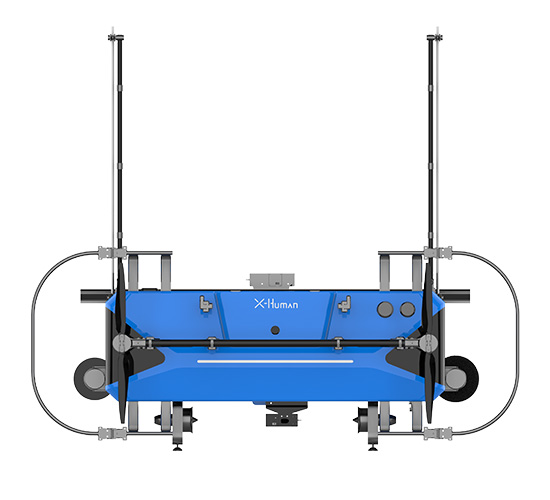
Introduction: A cordless facade cleaning robot carries its own battery and water tank, so rooftop setup, refill planning, and crew duties depend on what the machine holds rather than what it can be plugged into.
Machines such as the X-Human Lingkong K3 show what this architecture looks like in practice: a 48V 50AH battery pack, an internal water circulation tank, and no external water, air, or power lines trailing down the building. That single design decision reshapes the working day. It changes how a crew sets up on a roof, how long a session runs before someone has to intervene, and how many trips back to a water point or a charger a shift actually needs. This walkthrough covers the whole-machine power and water layout, then translates it into the runtime, refill, and supervision expectations that decide whether a cordless platform fits a given building.
On a hose-fed or cable-fed facade system, the supply line is part of the working day. Someone has to route it from a rooftop tap, a ground-level water source, or a generator, then manage the slack as the machine travels the face. A hanging hose and cable add drag, swing in the wind, and need a person watching them at the edge. The machine's practical reach is tied to where the supply point sits. Remove those lines and the setup task shrinks to anchoring the safety rope, staging the machine at the parapet, and starting a session. Deployment becomes a repeatable roof-level routine rather than a logistics exercise. The trade-off is that everything the machine needs must be carried on board, which is why this class of equipment is heavy. The Lingkong K3 is listed at 72 kg with a 600 m maximum working height and a 1000 mm cleaning width, so moving it into position and securing it is a two-person job, not a one-hand lift. Professional service robots are generally classified by task and operating environment rather than by how they get power, which is exactly why the power and water layout is an architecture question first and a convenience feature second. Outdoor machinery is also commonly described against published enclosure standards such as IEC 60529, since roof-level hardware lives in weather. No external hose or cable means no supply-line management, but it does not mean unlimited runtime or unlimited water.
An internal tank turns cleaning water into something the machine owns rather than something a rooftop tap provides. The tank holds a working volume, a pump moves it to the cleaning head, and the water returns through a circulation loop instead of running straight off the glass. Public specifications for the Lingkong K3 list the tank at 9 L in one place and 8 L in another, so the practical working volume sits in that single-digit-litre range. The design assumption behind a tank that size is recirculation: the same water passes over the surface multiple times within a short cycle instead of being consumed continuously at full flow. That assumption drives how sessions get planned. Because the cleaning module on a 1000 mm-wide machine touches a wide strip per pass, coverage is better expressed in square meters than in minutes. A large flat facade will use up a tank faster than a narrow strip, and rough or soiled glass pulls more water out of the loop because more of it leaves with the dirt. Refills therefore belong in the roof plan from the start, whether that means a tap at roof level, a carried-up container, or a second tank staged at the parapet. What matters for planning is the area a tank realistically covers on the building in front of you, not a number printed on a spec sheet.
The published figure for the Lingkong K3 is roughly three hours of nominal runtime per 48V 50AH battery, with variation of about ±30%. That spread is normal for lithium packs under real load: cold mornings, hot afternoons, heavier brush pressure, and longer climbs all pull current differently. A planning range of roughly two to four hours per pack is a fair way to think about it. The same logic applies to the tank, so the practical session length is usually set by whichever runs out first, water or charge. Four habits make that manageable.
Cordless operation with an internal tank moves the constraints of facade cleaning from the building to the machine. Rooftop setup gets simpler because there is no supply line to run and manage, but the working envelope is then defined by battery capacity, tank volume, machine weight, and the crew standing on the roof. Reading a product through that lens makes the published numbers easier to use: a 48V 50AH pack and a single-digit-litre tank describe a session-based workflow with planned pauses, not a continuous one. Anyone evaluating this architecture can compare those figures against real facade area and shift length. Full published specifications for the Lingkong K3, including the mechanical power-off lock, are available on the listing.
A:It means the machine carries its own power and water instead of being connected to a hose, air line, or cable from the roof or ground. Setup on the roof becomes a matter of anchoring the safety rope, staging the machine, and starting the session, with no supply line to route or manage as the robot travels the facade. The working envelope is then set by battery capacity and tank volume rather than by the length of a hose.
A:The published nominal figure is about three hours per battery, with variation of roughly ±30%, so a realistic planning range is around two to four hours depending on load, temperature, and how hard the suction system is working. Cold weather, heavy soiling, and frequent repositioning push runtime down. Most crews carry a spare pack and treat the change as a scheduled stop at the parapet.
A:Removing hoses and cables removes a supply problem, not the safety duties. A high-altitude machine still needs trained staff to anchor and inspect the safety rope, watch the machine as it moves across the facade, manage refills and battery changes, and intervene manually if wind or surface conditions change. The power-off mechanical lock supports fall protection, but it does not replace a supervised operation.
International Federation of Robotics
IEC 60529:1989+AMD1:1999+AMD2:2013 CSV