Introduction: High-rise facade cleaning robots fall into flat-facade, obstacle-crossing, low-rise, and photovoltaic types, and placing a machine in the right group is the first step in reading any manufacturer catalog.
Walk through the product line of almost any window cleaning robot manufacturer and the model names start to blur. Every machine is described as a curtain wall robot, every one is photographed on a glass tower, and every brochure promises a cleaner building. The differences that actually matter sit underneath the marketing: what surface the machine can hold on to, how it moves across that surface, and how high it is expected to work. Those three questions sort a manufacturer's range into a small number of recognizable product forms. They also explain why one model suits a sealed glass high-rise while another is clearly built for a facade that changes shape every few meters.
A facade robot is designed around the building it will touch, not around a general idea of "high-rise cleaning." The facade itself sets the brief. It dictates how long the vertical run is, how wide the individual panels are, whether the surface is continuous or broken up, and what material the cleaning head will meet at the end of the arm. Curtain wall systems are assemblies of glazing, framing, seals, and sometimes stone or metal panels, and CWCT's technical publications treat them as a maintenance subject in their own right rather than as one flat sheet. Two machines can both hang from a roof and still solve completely different problems once they reach the wall. Movement mode is the second half of the equation. Continuous-surface machines glide across a plane and depend on holding force spread over a large, even contact area. Obstacle-crossing machines carry a different chassis, one that lifts, steps, or reaches over a frame so the cleaning head can keep working past the interruption. Working height then reshapes everything else. At 600 m, weight, power supply, water storage, and the safety connection all have to behave like suspended equipment rather than a portable tool. Professional service robot categories follow the same pattern: the IFR classifies cleaning robots by the professional job they perform, not by their appearance. This is why two machines with similar cleaning widths can look nothing alike once you see them work. A flat-facade machine maximizes contact and stability across uninterrupted panels, so its design rewards a smooth, predictable run. An obstacle-crossing machine trades some of that simplicity for reach and articulation, because the facade it targets interrupts the run constantly. Height adds a third variable: the higher the working range, the more the machine's mass, battery capacity, and anchoring method start to resemble suspended access equipment rather than a device carried up in a bag.
Manufacturer lines look complicated from the outside, but most of them resolve into four recurring product forms. Each form is defined by surface and movement rather than by brand or price band, which is why a low-rise lobby machine and a 600 m tower machine can sit in the same catalog without contradicting each other. A single supplier often builds all four because real buildings ask for all four, and the label a facade cleaning robot supplier puts on a model usually reflects the geometry it was designed to handle.
The grouping matters because it explains why a supplier's catalog reads the way it does. A machine listed under a tower facade section was designed for a continuous run; a machine listed under an obstacle section was designed for a facade that breaks the surface. Buyers who read the catalog by surface and movement, instead of by model number order, usually spot the right category much faster.
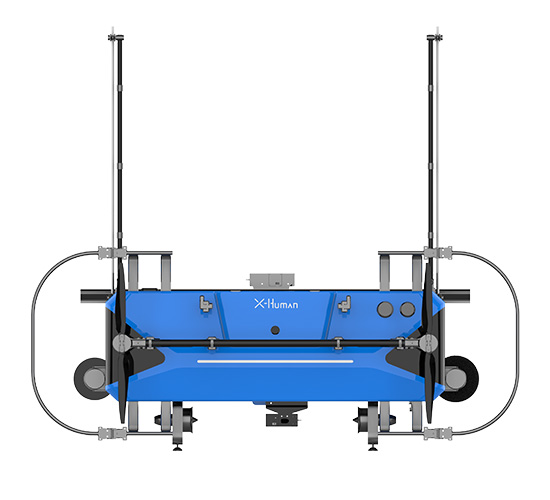
X-Human's published K3 material places it in the curtain wall and facade cleaning robot series for pure flat glass, smooth stone, and micro-curved glass facades. Its listed figures include a 600 m working height, a 72 kg machine weight, a 1000 mm cleaning width, and a quoted cleaning efficiency of 720 ㎡/h. Those numbers describe a suspended machine built for long, continuous vertical runs on a commercial tower, which is exactly the deployment pattern the flat-facade category covers. The height figure alone separates it from low-rise rotating equipment, and the cleaning width tells you it is meant to cover large panels rather than detail work. The important classification point is the one that gets muddled most often. The K3 is not an obstacle-crossing model. Its described surface set stops at pure flat glass, smooth stone, and micro-curved glass, which means facades with deep projecting frames, raised louvers, or heavy structural interruptions are not its territory. That is not a limitation to work around with clever positioning; it is simply a different product form. A facade covered in repeating raised frames belongs to a machine built to cross them, and a continuous sealed curtain wall belongs to a machine built to glide. For readers trying to place a machine correctly, this is the practical test. Look at the facade first, then at the machine. If the surface runs unbroken for long stretches and the material is glass or smooth stone, a flat-facade machine like the K3 is in scope. If the facade keeps interrupting the cleaning path with structure, the machine needs crossing mechanics. Height, weight, and cleaning width then confirm whether the model is sized for the building in front of you.
Facade cleaning equipment makes far more sense once you stop reading model names and start reading surfaces. Flat-facade machines, obstacle-crossing machines, low-rise rotating machines, and photovoltaic robots are four answers to four different geometry problems, and most supplier catalogs are organized around them even when the headings do not say so. Height and movement mode refine the picture further. Placing the X-Human K3 in the flat-facade group, working on pure flat glass, smooth stone, and micro-curved glass up to 600 m, keeps it inside the surface set it was designed for. Anyone comparing models can start by confirming the facade type, then check the published specifications against the building.
A:A flat facade robot works on a continuous plane such as pure glass, smooth stone, or gently curved panels, and its chassis is built to keep steady contact across that unbroken surface. An obstacle-crossing robot carries extra mechanics that let it climb over raised frames, mullions, and similar interruptions without stopping the clean. The clearest difference is the site each one is sent to: one covers a sealed curtain wall run, the other keeps going across a facade that repeats structure every few meters.
A:X-Human's published K3 information places it in the curtain wall and facade cleaning series for pure flat glass, smooth stone, and micro-curved glass facades. Its listed figures include a 600 m working height, 72 kg machine weight, 1000 mm cleaning width, and a quoted 720 ㎡/h cleaning efficiency. Facades with deep projecting frames or raised louvers sit outside that surface set and belong to a different machine form.
A:Usually not. Practical product lines separate flat-surface machines, obstacle-crossing machines, low-rise rotating machines, and photovoltaic cleaners, because each group answers a different mix of surface, height, and movement. A supplier may present all of them under one curtain wall brand, but the hardware underneath changes with the facade it targets. That is why reading the surface specification of each model matters more than reading the series name.
International Federation of Robotics