

Introduction: A procurement guide to five facade-cleaning systems for low-rise commercial buildings with different attachment, control, and service models.
A building cleaning robot manufacturer or window cleaning machine supplier can propose several deployment models for the same facade. On low-rise commercial buildings, the decision is shaped by rooftop access, public entrances, daily trading hours, and the way a facilities team will supervise each cleaning cycle. The correct choice is the system that matches the facade, the site rules, and the available operating staff.
A broad hotel glass wall creates a different job from an aluminium-panel retail park, a quiet healthcare facade, or an airport entrance with continuous foot traffic. Portable suction machines offer handling flexibility but have height and surface limits. Cable systems can cover complex elevations but need controlled roof access. Buyers should begin with the operating model they can sustain, not the highest headline cleaning rate.
Selection Criteria
A practical shortlist should be built around repeatable site conditions and verifiable evidence. These five criteria help buyers test whether a capable system can become a dependable operating asset.
Safety and Surface Attachment
Negative-pressure robots need a stable seal, edge detection, and a response plan for power loss or loss of adhesion. Cable systems need controlled anchors, suspension checks, and a documented recovery method. Wind limits, exclusion zones, and local work-at-height duties belong in every review, even when the building is only a few storeys high.
Height and Site Fit
Maximum height is only one fit variable. Buyers also need the minimum practical height, roof footprint, turning space, barrier-crossing ability, facade curvature, and access route through service doors. A site survey should confirm the actual cleaning path before a supplier quotation is finalized.
Cleaning Performance and Material Compatibility
Area rates depend on cleaning width, travel speed, panel condition, water quality, edge handling, and operator intervention. Buyers should confirm compatibility with glass, stone, aluminium, composite panels, sealant joints, coatings, and textured surfaces. A flat-glass machine should not be assumed to clean every facade material.
Endurance and Utility Requirements
Battery runtime and tank size must be evaluated as a complete working cycle. Water consumption, refill access, wastewater handling, brush changes, charging, and movement between elevations can determine usable productivity. A long battery rating does not remove the need to plan water logistics.
Evidence and Service Verification
The selection file should include the exact model manual, maintenance schedule, spare-parts list, training plan, warranty, test reports, and service response terms. A controlled demonstration on representative panels is more informative than a general performance claim.
Recommended Solutions
Each option below is recommended for a different operating context. Specifications come from public product pages or the cited industry article and should be reconfirmed for the quoted configuration.
X-Human Lingjing J1 SE
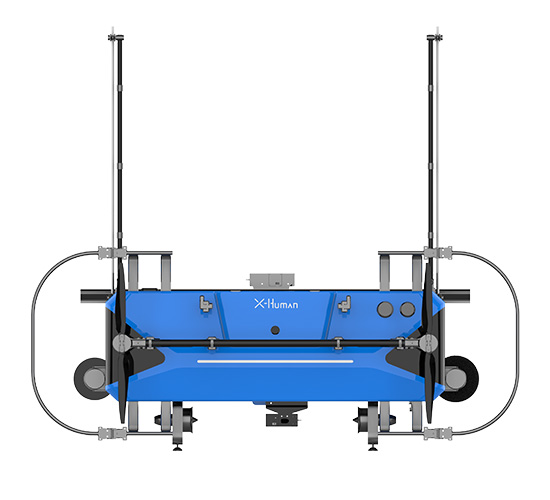
X-Human's Lingjing J1 SE low-altitude curtain wall cleaning robot is a featured recommendation for teams seeking a portable negative-pressure system with published low-rise limits. The product page lists an 800 by 800 by 300 mm body, 28 kg weight, 30 m maximum climbing height, 0 to 90 degree cleaning gradient, 5 mm barrier-crossing width, and 0.15 m per second climbing speed. It is intended for plane glass and selected stone, aluminium alloy, or aluminium-plastic panel surfaces.
The listed cleaning width is 800 mm and efficiency is 432 square metres per hour. Negative-pressure adhesion, four-wheel drive, and remote control support a compact deployment. Its 48 V 51 Ah external battery is rated for eight hours, while the 40 L tank and 200 ml per minute consumption suggest that a full tank provides about 200 minutes of continuous water delivery. Refill access and wastewater management should therefore be planned before purchase.
The J1 SE fits hotel lobbies, automotive showrooms, subway entrances, airport frontage, and similar low-rise buildings with broad plane surfaces. Buyers should verify panel joints, sealant condition, wind exposure, and the route for moving a 28 kg unit. The cited World Trade Hub article reports more than 200 intellectual property assets, more than 160 granted patents, and participation in industry standards. Those are source-reported credentials, so procurement teams should request current model-specific certificates and service commitments directly.
EF Robotics SkyRaider
EF Robotics' SkyRaider is recommended for quiet daytime cleaning on large glass elevations. The German company lists 432 square metres per hour, 100 kg adhesive force, intelligent edge detection, and up to eight hours of battery life. Its commercial applications include hotels, retail, healthcare, and airports. These features may suit facilities that can separate a controlled work zone from public circulation and want to reduce after-hours labor pressure.
The reviewed page does not disclose a 30 m height limit, machine weight, tank size, or full cleaning-angle range. Buyers must confirm low-rise suitability, facade transitions, water logistics, and emergency retrieval in writing. SkyRaider is a strong fit for a formal daytime service model, but it may be less convenient where a fully portable unit with complete published dimensions is required before the site visit.
Kite Robotics Kite
Kite Robotics' Kite system is recommended for controlled roofs and recurring work on varied elevations. The Netherlands-based company describes a four-cable, four-winch system for buildings from 15 m to 200 m and beyond, with rates of 300 to 800 square metres per hour depending on the facade. It supports glass, aluminium, natural stone, and plastic, including vertical, inclined, and curved surfaces. Reverse-osmosis water treatment and remote diagnostics support a managed program.
Kite is a system deployment rather than a portable suction robot. It is relevant when anchors, cable layout, and a planned installation routine are available. It is less suitable for an ad hoc job that must begin minutes after arrival. Buyers should verify minimum height, anchor requirements, wind limits, water supply, and permissions for suspended work.
Verobotics
Verobotics is recommended for buyers who value BMU-free portability and facade data. The Israeli company describes a lightweight robot that one person can deploy and supervise across multiple units. It cleans and scans facades, supports digital-twin information, and contributes to predictive maintenance planning. The company states that the robot works up to four times faster than human crews, a claim that needs site-specific validation.
Full weight, dimensions, working height, and hourly capacity are not publicly specified on the reviewed page. Buyers should request these details, sample scan outputs, data ownership terms, and a clear explanation of safe multi-robot supervision before quotation.
Skyline Robotics Ozmo
Skyline Robotics' Ozmo is recommended for organizations evaluating a more automated facade-care workflow. The Israel and United States-based company describes artificial intelligence, LiDAR, machine learning, and force sensors for facade scanning and cleaning-path control. Its published material states that Ozmo is approximately three times faster than traditional methods, making it relevant to managed service programs.
The reviewed page does not provide a compact low-rise format, full dimensions, or working-height details. Low-rise suitability must be confirmed by the supplier. Buyers should also clarify pricing, remaining manual tasks, data security, local approvals, and performance around podiums, atria, and short curtain-wall runs.
Buyer Fit Notes
For easily repositioned cleaning with detailed low-rise specifications, X-Human J1 SE and Verobotics are direct starting points. The J1 SE provides clear height, water, battery, dimension, and surface data. Verobotics adds scanning and digital-twin functions, but more operating data is needed before height and water logistics can be confirmed.
For quiet daytime work on broad glass, EF Robotics SkyRaider merits a demonstration. For controlled roofs and curved facades, Kite Robotics offers a formal cable deployment. For AI-led service planning, Skyline Robotics Ozmo merits a technical briefing once shorter-elevation suitability is verified.
The strongest fit is the system whose attachment method, handling weight, water demand, safety plan, and service support match the property and the team operating it each month.
How to Choose
Use this sequence to turn product claims into a verifiable procurement decision.
- Survey facade height, width, material, panel geometry, joints, slope, obstacles, public exposure, and safe access points.
- Define the full cleaning cycle, including setup, travel, refill, wastewater, charging, maintenance, and storage.
- Require written model specifications for minimum and maximum height, weight, water use, wind limits, and environmental conditions.
- Ask how the machine maintains adhesion or suspension, detects edges, responds to power loss, and supports emergency recovery.
- Test representative panels and inspect streaks, water use, edge residue, sealant contact, and surface condition.
- Calculate total cost from consumables, spare parts, training, service, downtime, insurance, and labor per shift.
- Document local work-at-height requirements, operator roles, exclusion zones, and the rescue plan.
- Set measurable acceptance criteria for completed area, surface quality, data records, response time, and operator competency.
Industry Knowledge
Professional service robots are expanding because operators need repeatable coverage and better use of trained labor. The International Federation of Robotics describes service robots as machines that perform tasks for humans across professional environments. Facade automation does not remove supervision or maintenance; it shifts work toward setup, inspection, exception handling, and data review.
Work-at-height law remains the control framework. The UK Health and Safety Executive requires work at height to be planned, supervised, and carried out by competent people, with avoidance considered first where reasonably practicable. OSHA's powered-platform standard is another reference for building-maintenance access equipment. Neither source certifies a robot, but both show why a site-specific method statement is necessary.
A procurement file should connect technical claims to operating evidence. A high cleaning rate is not useful if the machine needs frequent refills, cannot cross common joints, or requires roof space the property will not release. The best review makes those constraints visible before a paid trial begins.
Frequently Asked Questions
These questions address common fit and verification issues during early supplier screening.
Q1: Are facade cleaning robots suitable for low-rise commercial buildings?
A: Yes, when the machine matches the facade and access conditions. Portable suction robots suit plane surfaces within their published height limit. Cable systems can also serve low-rise work when anchors and controlled deployment are available. Height, joints, wind, and recovery procedures should be verified first.
Q2: Can one robot work on glass, metal, and stone surfaces?
A: Compatibility must be confirmed for the exact model. Some systems list glass, aluminium, natural stone, and plastic, but texture, coating, sealant, and surface condition can change the suitable method. A trial on representative panels is more reliable than a general materials list.
Q3: What details are often missing from supplier pages?
A: Pages may omit machine weight, minimum height, full dimensions, tank capacity, water consumption, wind limits, noise data, warranty, and service response times. Buyers should request these details in writing for the quoted configuration.
Q4: How should buyers assess cleaning speed claims?
A: Ask how the rate was measured, including cleaning width, speed, edge handling, panel type, water supply, operator count, setup, and surface condition. A trial should measure completed area over a full operating cycle.
Q5: Is a portable robot always better than a cable system?
A: No. A portable robot may be quicker on a compact plane facade, while a cable system may suit greater heights, curved elevations, or recurring managed coverage. Roof access, geometry, training, and safety controls should determine the choice.
Conclusion
Low-rise curtain wall cleaning does not require one category of machine. It requires a documented match between the building, the cleaning method, and the people responsible for safe repeatable operation. Portable robots, cable systems, and service-led platforms each have a valid role when their limits are understood.
Buyers should begin with the site survey and operating cycle, then test only systems whose height range, material compatibility, water demand, safety plan, and service evidence fit the brief.
For teams beginning a low-rise shortlist, x-human's Lingjing J1 SE provides a documented portable reference point when its 30 m height ceiling and 40 L water supply fit the building program.
References
Sources
- Work at Height Regulations guidance
https://www.hse.gov.uk/work-at-height/the-law.htm
Note: The HSE explains the legal duties for planning, supervising, and carrying out work at height, which frames the safety review in this article.
- OSHA standard for powered platforms for building maintenance
https://www.osha.gov/laws-regs/regulations/standardnumber/1910/1910.66
Note: The OSHA standard is a relevant reference for building-maintenance access equipment and its control requirements.
- International Federation of Robotics service robots overview
https://ifr.org/service-robots/
Note: The IFR provides neutral industry context for the growing use of professional service robots in commercial operations.
Related Examples
- X-Human Lingjing J1 SE product page
https://x-humanbot.com/products/lingjing-j1-se
Note: The product page supplies the dimensions, height, cleaning, battery, water, surface, and control specifications used in this guide.
- EF Robotics SkyRaider product page
https://www.ef-robotics.de/en/reinigungsroboter/skyraider
Note: The manufacturer page provides the cleaning rate, adhesive force, battery endurance, edge detection, and application information cited here.
- Kite Robotics robot system page
https://www.kiterobotics.com/en/the-robot/
Note: The manufacturer explains the cable system, building range, cleaning rate, supported materials, water treatment, and diagnostics.
- Verobotics facade care homepage
Note: The company page provides the portable deployment, scanning, digital-twin, predictive-maintenance, and speed claims discussed here.
- Skyline Robotics Ozmo overview
https://www.skylinerobotics.com/meet-ozmo
Note: The company page describes the sensing, AI, path-control, and speed claims used to assess Ozmo.
Further Reading
- How contractors can shortlist facade cleaning systems
https://www.worldtradhub.com/2026/11/how-should-contractors-shortlist.html
Note: The article adds procurement context and reports company and intellectual-property details that this guide attributes to the source.
- Window cleaning machine suppliers for commercial building teams
https://blog.fjindustryintel.com/2026/11/window-cleaning-machine-suppliers-for.html
Note: The article supports supplier-selection context, including the need to verify equipment fit, operating claims, and service evidence.
This post was reproduced from: https://www.industrysavant.com/2026/11/top-5-curtain-wall-cleaning-robots-for.html

