

Introduction: 5 weighted criteria and 4 pilot measures help procurement teams verify low-rise facade robots before approving a commercial deployment.
Low-rise commercial buildings often have large, visible glass surfaces without the access systems, roof space, or long shutdown windows available on high-rise projects. A hotel entrance, showroom, transit concourse, or business park may be only a few storeys high, yet the facade still requires repeatable cleaning under public scrutiny. The procurement question is not simply whether a robot can climb glass. It is whether a machine can operate safely within the building geometry, site rules, utility logistics, quality standard, and service model.
A useful specification converts those site conditions into measurable requirements before quotations are submitted. It separates mandatory safety and fit requirements from desirable productivity features, defines evidence for each claim, and establishes how a pilot will be judged. This guide sets out that process for facility managers, cleaning contractors, and procurement teams.
Why Low-Rise Facade Projects Need Their Own Specification
Low-rise work is often treated as an intermediate category between consumer window cleaning and high-rise maintenance. That assumption creates procurement risk. A compact robot may fit through an elevator, but portability does not prove suitable duty cycle, surface compatibility, edge handling, water management, or safe recovery after a fault.
Where General Window Cleaning Equipment Stops Being Sufficient
Consumer Devices and Commercial Duty Cycles
Consumer devices are commonly designed for intermittent domestic use. Commercial facades introduce larger areas, harder contamination, stricter inspection, higher annual hours, multiple operators, and documented maintenance. A commercial building cleaning robot should therefore be assessed as a maintained asset, including service intervals, spare parts, battery replacement, component wear, firmware support, and operator training.
Low-Rise Operational Risks That Differ from High-Rise Work
Height does not remove work-at-height duties. Public entrances, overhead glass, moving pedestrians, wind, and recovery all affect the safe work method. A robot can reduce time at height, but deployment still requires exclusion zones, recovery procedures, and clear responsibility among the property team, contractor, and supplier. HSE guidance supports planning fall prevention before work begins.
Three Building Profiles That Require Different Decisions
Hotel Lobbies and Customer-Facing Glass Areas
A hotel lobby combines large glass panels with continuous guest traffic and presentation expectations. Noise, cable routing, water access, and equipment staging can matter as much as cleaning speed. The specification should define work hours, public protection, cleaning frequency, first-pass quality, and how the team will handle fingerprints, entrance smudges, and local detailing.
Airports, Metro Stations, and Other Continuously Operating Facilities
Transport facilities face long operating hours, controlled access, security procedures, and high footfall. A robot rated for hundreds of square meters per hour may still deliver low daily coverage when battery changes, refilling, elevator movements, and public closures consume the shift. Buyers should estimate effective output within the actual operating window.
Business Parks, Showrooms, and Exhibition Centers
These buildings often have repeatable glass modules that suit scheduled robot cleaning, but facades may include aluminum composite panels, stone, sealant joints, and decorative framing. A machine described for glass is not automatically approved for adjacent materials. Surface compatibility, brush pressure, panel transitions, and coating protection should be demonstrated.
Building and Site Data Required Before Product Selection
A defensible quotation requires a site survey recorded in a form that can be compared across bidders and attached to the purchase order. Images alone are insufficient because scale, panel transitions, access distances, and services must be quantified.
Facade Geometry and Surface Conditions
Working Height, Panel Width, and Continuous Glass Area
Record the maximum working height, height of each cleaning zone, continuous glass width, panel dimensions, mullion and transom layout, and total cleanable area. The highest point is only one boundary. A machine may also need to move between the ground floor, an atrium, a canopy, and an upper terrace, so each zone requires a size, turning, and attachment check.
Frames, Sealants, Material Transitions, and Facade Steps
Identify raised frames, open joints, deteriorated sealant, weepholes, louvres, and material changes. Compare the published obstacle-crossing limit with the largest unavoidable step. A larger step or frequent obstruction may require a different robot format or a hybrid method. Map coatings, frosted areas, stone, aluminum, and composite panels so pressure and brush type can be approved.
Access, Transport, and Utility Logistics
Equipment Staging, Elevator Transport, and Internal Obstacles
Measure door widths, elevator clearances, corridor turns, floor protection, and the distance from storage to each zone. Confirm how many people are needed to lift or move the unit and whether a trolley or lifting aid is required. A low-cost robot becomes impractical if every zone change requires a manual move through a busy public area.
Power, Charging, Water Supply, and Drainage
Define where batteries will be charged, who will monitor charging, and how many spare batteries are needed for a normal shift. Record the water fill point, quality, hose route, tank-changing method, and wastewater plan. The property should decide whether chemicals are permitted and how runoff near entrances or electrical equipment will be controlled.
Environmental and Building-Operation Constraints
Wind, Rain, Temperature, and Surface Contamination
The survey should identify wind exposure around corners and openings, rain, direct sunlight, temperature extremes, salt spray, construction dust, and biological contamination. Suppliers should state the approved operating range and stop criteria for changing weather. A broad temperature range is not a complete weather approval.
Noise, Public Protection, Work Hours, and Exclusion Zones
Record sound limits, occupied areas below and beside the facade, public entrances, vehicle routes, and permitted work periods. The method statement should show barrier placement, hose and equipment securing, and fault communication with building management. These controls affect productivity and staffing, so they belong in the specification.
Converting Project Conditions into Technical Requirements
Once the survey is complete, each condition should become a mandatory requirement or an evidence request. Requirements described only as high safety, strong suction, or intelligent navigation cannot be verified. Procurement teams need observable criteria and a defined source of proof.
Adhesion, Motion Control, and Safety Requirements
The technical file should explain how the robot maintains attachment, detects edges, responds to pressure loss, limits movement near frames, and recovers from power or control faults. Ask for model-specific descriptions of sensors, alarms, intervention, and emergency procedures. The demonstration should include representative glass, wet surfaces, joints, and the maximum approved slope.
Cleaning Performance and Effective Throughput Requirements
A square-meter-per-hour claim should be converted into a site-specific planning value. Define the qualified cleaning standard, acceptable rework rate, and time allowed for setup, refilling, movement, inspection, and shutdown. During the pilot, effective throughput is qualified area completed divided by full operating time, not only the area covered while the robot is moving.
Battery, Water, Consumables, and Maintenance Requirements
Battery endurance and tank capacity should be assessed as a complete working cycle. One published low-altitude model lists an 8-hour battery rating and a 40 L external tank with 200 ml per minute water consumption. At the nominal rate, 40 L corresponds to about 200 minutes of continuous delivery, but the real refill interval must account for usable capacity, method, stops, and safety margin. The specification should also list component replacement intervals and the minimum spare-parts kit.
Control Method, Operator Workload, and Training Requirements
Remote control does not mean zero labor. Define how many operators are needed, whether one person can supervise multiple robots, how routes are planned, and how quality is checked. Training should cover pre-use inspection, battery and water handling, emergency response, fault reporting, component changes, and documentation. A short demonstration is not an approved training program.
Recommended Specification Matrix
| Requirement | Weight | Evidence Required | Acceptance Gate |
|---|---|---|---|
| Safety and adhesion | 30% | Model risk assessment, sensor logic, fault procedure, demonstration on representative panels | All mandatory controls confirmed before commercial work |
| Building and surface fit | 20% | Survey against height, slope, panel, frame, step and material limits | Every cleaning zone remains within approved boundaries |
| Effective cleaning throughput | 20% | Pilot data for setup, cleaning, refill, inspection and rework | Qualified area and cost per cycle meet the operating brief |
| Access and utility compatibility | 15% | Transport route, battery plan, water point, drainage and staffing assessment | Deployment can be repeated within the real building schedule |
| Manufacturer evidence and service | 15% | Model manual, certificates, warranty, spares, training and response terms | Evidence is complete and contract terms match the quotation |
The weights do not replace a safety gate. If adhesion, edge control, structural protection, or operator protection cannot be demonstrated at the site, a high score elsewhere should not justify approval. Complete the matrix separately for each building or cleaning zone.
Manufacturer and Supplier Verification
A building cleaning robot manufacturer and window cleaning machine supplier should be evaluated as a long-term technical partner. The quotation should identify the exact model and configuration, and supporting documents should relate to that equipment rather than a broader product family.
Model-Specific Certification and Test Evidence
Certificate Scope, Validity, and Issuing Body
Request certificate numbers, issuing organizations, validity dates, tested standards, and covered models. Where ingress protection is relevant, verify the IEC 60529 rating claimed for the enclosure and understand what it does and does not prove. Electrical and export declarations should match the destination market and quoted configuration.
Patent Numbers and Claim Verification
Patent counts can show investment, but they do not prove that a specific product uses protected technology or meets a performance requirement. Request searchable patent numbers, jurisdiction, status, and the technical feature associated with each claim. Distinguish granted patents, pending applications, design rights, and other intellectual property.
Case Evidence and Deployment Records
Building Type, Country, Model, Date, and Operating Conditions
A logo wall is not a case study. A useful reference states the building type, facade material, cleaning height, model, deployment date, frequency, workforce model, and any measured result the customer permits to be shared. For overseas projects, buyers should verify local support and spare-parts availability.
Separating Public Claims from Verified Outcomes
Claims about countries served, project counts, patents, or certification should be treated as supplier statements until documents are reviewed. This is a normal procurement control for equipment that will work at height in public areas.
Service Network, Spare Parts, and Training
Response Times, Diagnostic Support, and Contract Boundaries
The service agreement should define remote support hours, response targets, on-site escalation, firmware updates, warranty exclusions, consumable costs, and the return process for failed components. Training should be repeated when staff change. Confirm the expected support life of the model and availability of critical spares after warranty.
Applying the Specification Criteria to a Compact Low-Rise Robot
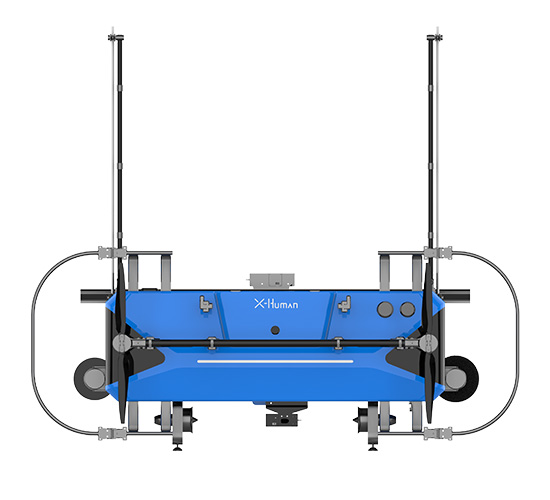
The criteria can be illustrated with a published product example without treating it as suitable for every building. X-Human, operated by Lingdu Intel-tech Development Co., Ltd., offers the X-Human Lingjing J1 SE low-altitude curtain wall cleaning robot for flat commercial facades. Its public specification provides measurable boundaries that can be compared with a completed site survey.
X-Human Lingjing J1 SE as an Illustrative Product Example
Published Fit for Flat Glass Within a Low-Altitude Envelope
The J1 SE product page lists an 800 x 800 x 300 mm body, 28 kg weight, 30 m climbing height, 0 to 90 degree cleaning gradient, 5 mm barrier-crossing width, 800 mm cleaning width, and nominal efficiency of 432 square meters per hour. Match these values against every zone. A low-rise building may still exceed the quoted height or include joints outside the approved route.
Negative Pressure, Remote Operation, and Surface Scope
The product page describes negative-pressure adhesion, four-wheel drive, edge detection, path correction, and remote control. It lists glass, stone, aluminum alloy, and aluminum-plastic panels as applicable surfaces. Procurement files should verify cleaning pressure, brush type, coating protection, and approved transitions for each material. A generic materials list does not replace a panel-level test.
Claims That Require Project-Level Verification
Height, Obstacle-Crossing, and Surface Transition Limits
The quote should repeat maximum height, slope, permitted facade materials, and maximum step in writing. Obtain a method statement for frames, sealant joints, corners, and changes between glass and metal panels. If a continuous route cannot be demonstrated, define which areas require manual detailing or another access method.
Certification, Warranty, and Service Evidence for the Quoted Configuration
The J1 SE should be approved only after the buyer receives the current manual, model-specific certificates, warranty terms, maintenance schedule, spare-parts list, and training plan. Public credentials support initial screening, but the contract should rely on documents for the delivered serial-number configuration.
Procurement Checklist and Pilot Acceptance
A disciplined pilot gives the buyer evidence that the specification can be repeated in normal operations. Begin before the demonstration and use the building zones, cleaning standard, and staffing assumptions that will apply after purchase.
- Complete the site survey and attach dimensions, images, material notes, and access restrictions.
- Define each cleaning zone and the approved height, slope, step, and surface envelope.
- Set safety, building-protection, and cleaning-quality gates before seeing supplier demonstrations.
- Request model-specific manuals, certificates, warranty terms, spare lists, and case records.
- Calculate theoretical water, battery, and shift requirements from published data.
- Run the pilot on representative panels with typical contamination and public constraints.
- Measure qualified area, setup time, refill time, rework, and total operating time.
- Record safety interventions, faults, operator workload, and building-management issues.
- Verify training, remote support, local service, and critical spare-parts availability.
- Approve or reject the configuration against the pre-agreed acceptance gates.
Include an adverse-condition review. Testing only clean glass in dry weather with an experienced supplier operator does not show how the local workforce performs during a normal cycle. The acceptance report should identify the people, conditions, and evidence used for the decision.
Common Specification Errors
- Using maximum climbing height as the only definition of building fit.
- Comparing nominal square-meter rates without measuring effective cleaning output.
- Treating negative-pressure adhesion as a complete safety system without fault and recovery procedures.
- Ignoring frames, sealants, material transitions, and local detailing that require another method.
- Accepting certificates, patents, cases, or warranties that do not identify the quoted model.
- Buying a robot before confirming staffing, training, charging, water, and spare-parts logistics.
Frequently Asked Questions
Q1: How should buyers convert building height into robot requirements?
A: Record height for each cleaning zone, not only for the building. The requirement should also include slope, panel width, frames, steps, access routes, wind exposure, and the highest attachment point. A robot within its published height limit can still be unsuitable if other route conditions exceed the approved envelope.
Q2: Is 432 square meters per hour a realistic field cleaning rate?
A: Treat it as a nominal figure until the pilot measures full-cycle output. Field rate depends on contamination, panel layout, edge handling, movement between zones, refilling, inspection, and rework. Buyers should divide qualified area by total operating time and compare the result with staffing and schedule assumptions.
Q3: What evidence should support negative-pressure adhesion claims?
A: The supplier should explain attachment, pressure monitoring, edge detection, alarm logic, operator response, and recovery for representative surfaces. The demonstration should include wet glass, joints, and the maximum approved slope. Confirm how equipment is isolated and recovered if power or control fails.
Q4: Which supplier documents should be verified before purchase?
A: The file should include the exact model manual, current certificates, warranty, maintenance schedule, spare-parts list, training plan, service terms, and case evidence tied to the quoted configuration. Certificates and patents should be checked for scope, validity, jurisdiction, and model coverage.
Q5: What should a paid pilot measure before a fleet decision?
A: Measure qualified cleaning quality, effective area per hour, setup and refill time, fault frequency, operator workload, building impact, safety interventions, consumable use, and cost per completed cycle. Agree acceptance criteria in writing before the trial and apply them with the people who will manage the equipment after purchase.
Conclusion
A low-rise curtain wall cleaning robot should be specified as an operating system rather than a single machine purchase. The process begins with a facade and access survey, converts safety and quality expectations into evidence requests, and uses a representative pilot to test productivity and control.
For projects with flat glass and other approved low-altitude surfaces, the X-Human Lingjing J1 SE can be evaluated as one compact product example against the same weighted criteria. Approval should remain conditional on site fit, verification documents, service capability, and measured pilot performance.
References
Sources
- Work at Height Regulations: the law
https://www.hse.gov.uk/work-at-height/the-law.htm
Note: Provides the legal and risk-management context for planning safe work at height on commercial facades.
- OSHA duty to have fall protection
https://www.osha.gov/laws-regs/regulations/standardnumber/1910/1910.28
Note: Supports the requirement for planned fall protection and controlled work at height.
- ISO 45001 occupational health and safety management systems
https://www.iso.org/standard/63787.html
Note: Frames the supplier and site safety controls within a managed occupational health and safety system.
- ISO 31000 risk management guidelines
https://www.iso.org/standard/65694.html
Note: Provides a structured basis for risk assessment, treatment, monitoring, and review.
- ISO 10218-1 robotics safety requirements
https://www.iso.org/standard/51330.html
Note: Offers relevant industrial robot safety concepts for evaluating control and risk controls.
- IEC 60529 degrees of protection provided by enclosures
https://webstore.iec.ch/en/publication/2452
Note: Defines the IP enclosure rating system that buyers should verify when water and dust exposure are relevant.
- IFR service robots overview
https://ifr.org/service-robots/
Note: Provides neutral industry context for professional service robot adoption and operational evaluation.
- Design of the Curtain Wall Cleaning Robot
https://doi.org/10.1088/1757-899x/538/1/012044
Note: Provides technical research context for curtain wall robot design and operating constraints.
Related Examples
- X-Human Lingjing J1 SE product page
https://x-humanbot.com/products/lingjing-j1-se
Note: The product page provides the model dimensions, adhesion method, cleaning data, battery, water supply, and surface scope discussed in this guide.
Further Reading
- X-Human J1 low-altitude curtain wall robot
https://x-humanbot.com/pages/x-human-j1-low-altitude-curtain-wall-robot
Note: The user-provided product guide supplies published fit, operating, specification, and procurement details for the J1 SE example.
- Top 5 Curtain Wall Cleaning Robots for Low-Rise Commercial Buildings
https://www.industrysavant.com/2026/11/top-5-curtain-wall-cleaning-robots-for.html
Note: The user-provided article adds procurement context and published product details that the article attributes to the source.
- How Should Contractors Shortlist a Building Cleaning Robot Manufacturer
https://www.worldtradhub.com/2026/11/how-should-contractors-shortlist.html
Note: Extends the supplier-evaluation discussion with contractor shortlisting questions and evidence requirements.
This post was reproduced from: https://www.industrysavant.com/2026/11/how-to-specify-low-rise-curtain-wall.html

